Forged vs Cast Wheels: Which Is Right for Your Build?
A new set of wheels can be the centrepiece of a build, but the manufacturing method deserves as much thought as the finish. If two sets look equally good, does the forged one justify a higher bill? And will you notice the difference on the school run or a favourite country road?
Start with a wheel that meets your car's requirements, then compare its actual weight, price and intended use. Casting, flow forming and forging describe how a wheel is made. They do not replace evidence about the finished product.
This guide focuses on aluminium passenger-car wheels. It gives you a way to spend where the benefits match your priorities, whether you want a daily driver, a weekend project or a car for regular track days.
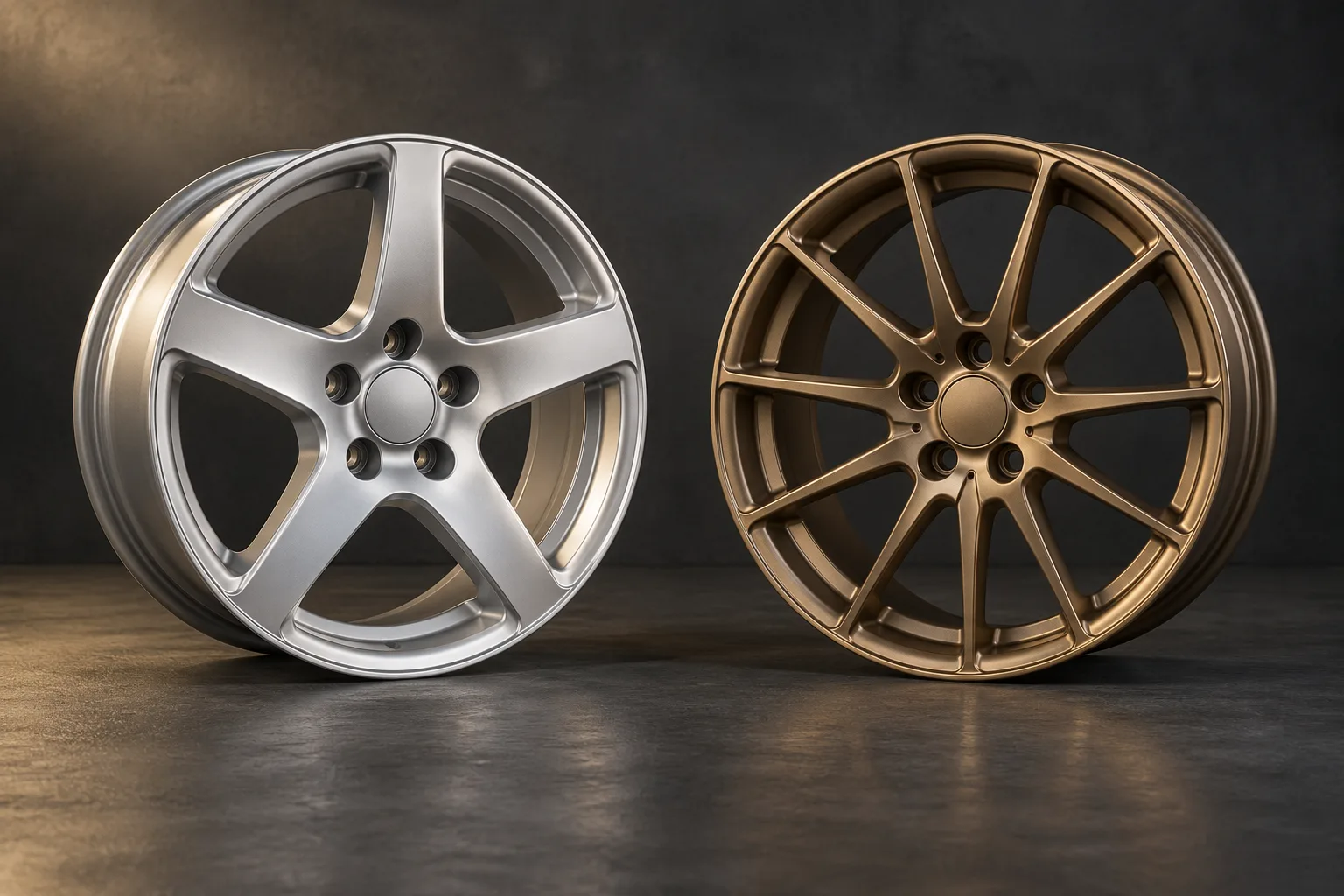 A wheel's appearance does not identify its manufacturing method. These generic designs illustrate a choice of shapes and finishes, rather than particular cast or forged products. Original AI-generated illustration created for this article.
Choose around your priorities
Treat construction as one item on a shortlist. A lower purchase price can leave room for the tyres you want, fitting and a replacement reserve. A more expensive wheel needs a benefit you can explain: a verified weight saving, a suitable specification or documented performance for your intended use.
Here is a starting point for the comparison. The manufacturing differences follow the explanations from OZ, BBS and OTTO FUCHS. The buying priorities are suggestions, rather than a ranking of every wheel on sale.
| Construction | What happens to the metal | Main reason to consider it | What to verify |
|---|---|---|---|
| Cast | Molten alloy takes the shape of a mould | A design you like at a manageable price | Finished-wheel weight, load rating and application |
| Flow-formed from a cast blank | Rollers form the rim while the centre remains cast | A possible weight saving within a smaller budget | Which parts are formed and the exact specification |
| Fully forged | A solid blank is pressed before subsequent forming and machining | Weight and design targets that justify the premium | Measured benefits, test evidence and replacement cost |
For a daily driver, start by comparing suitable cast and flow-formed options. Add forged wheels when the figures or a particular design make a convincing case. For a track-focused project, give more attention to testing, stiffness and the supplier's guidance on your use.
Set a total budget before browsing. Decide whether it must cover tyres, pressure sensors, fasteners and installation as well as the wheels. This turns a vague preference for the most sophisticated process into a comparison you can actually make.
What casting and forging actually change
Casting starts with molten aluminium alloy, which enters a mould and solidifies. Manufacturers use different casting processes. OZ's production guide, for example, describes gravity casting and low-pressure casting. In the latter, pressure feeds the alloy into the mould from below. The shared principle is that liquid metal takes the wheel's basic shape.
Forging shapes a solid piece of metal under pressure. That starting piece is often called a billet or blank. Heating helps the metal deform during production; subsequent operations create the rim, openings and final surfaces. OTTO FUCHS's process description includes press stages, rim rolling, heat treatment and machining. Forging is a sequence of manufacturing steps, rather than a finished wheel emerging from one squeeze.
The process changes the metal's internal structure. BBS Japan explains how compression produces a forged structure with metal flow lines. Those lines describe the material inside the wheel, not a pattern you can identify from the paint or spoke style.
The useful distinction is between material strength and finished-wheel design. Strength concerns resistance to permanent deformation or failure. A stronger material can give the designer scope to use less of it, but the amount removed still matters. Apex's engineering explanation makes this point directly: the finished design determines the outcome.
You may also see monoblock, meaning a one-piece wheel. That describes the number of pieces, not the production method. The cast and forged RAYS examples in the price section are both one-piece wheels. Ask for the manufacturing specification separately from terms describing assembly, finish or appearance.
Where flow-formed wheels fit
Flow forming deserves a place in the comparison because the choice is not limited to basic casting or full forging. For a wheel made from a cast blank, rollers work the rotating rim over a shaped tool, forming its width and profile. The centre, including the spokes, remains cast.
BBS describes this rim-forming process and explains that it changes the properties of the worked rim material. The process can support a lighter rim than conventional casting while retaining the cast centre. This is why a flow-formed product can be worth considering between your cast and fully forged candidates.
Keep the description precise. A formed rim does not establish that the whole wheel was forged. If a product name includes words such as “forged”, ask the manufacturer what happens to the centre and what happens to the barrel, the cylindrical part that carries the tyre.
There is another useful nuance: fully forged wheels can also have their rims rolled during manufacture. OTTO FUCHS shows this step after forging the wheel blank. The presence of rollers therefore does not, by itself, distinguish the two routes. The starting material and the treatment of the centre are what you need to establish.
For shopping purposes, record the process in plain language beside each model. “Cast centre, flow-formed rim” tells you more than a badge. Then compare the weight, price and test information. Do not give a wheel extra credit simply because its description sounds close to a more expensive construction method.
Compare the weight of the complete package
Forged construction offers scope for weight reduction, but it is not a weight figure. Compare the exact diameter, width, offset and application you intend to order. A number for another size in the same range does not answer your question.
Nor does forging make aluminium dramatically lighter. Enkei's engineering guide explains that the alloys used for casting and forging have very similar density. Savings come from the material and design allowing a different amount or distribution of metal. A larger or more substantial forged wheel can therefore miss the weight target you set.
Why care about the result? Wheels and tyres form part of the unsprung mass, the parts that move with the road beneath the suspension springs. Lower mass can help the tyre follow an uneven surface. Porsche explains that principle in its discussion of lightweight wheels. That supports the reason for reducing weight, rather than a guaranteed change in ride quality for your car.
The wheel also rotates. Rotational inertia describes how strongly an object resists a change in its rotation. Its mass and the distance of that mass from the axis both matter, as OpenStax explains. For an equal small mass, doubling that distance multiplies its contribution to rotational inertia by four. A scale reading is useful, but it does not describe the whole distribution.
Use straightforward arithmetic for the saving you can establish. Suppose each original wheel weighs 11.0 kg and each replacement weighs 8.5 kg. The saving is 11.0 − 8.5 = 2.5 kg per wheel, or 10.0 kg across four wheels. These are hypothetical figures, not product measurements.
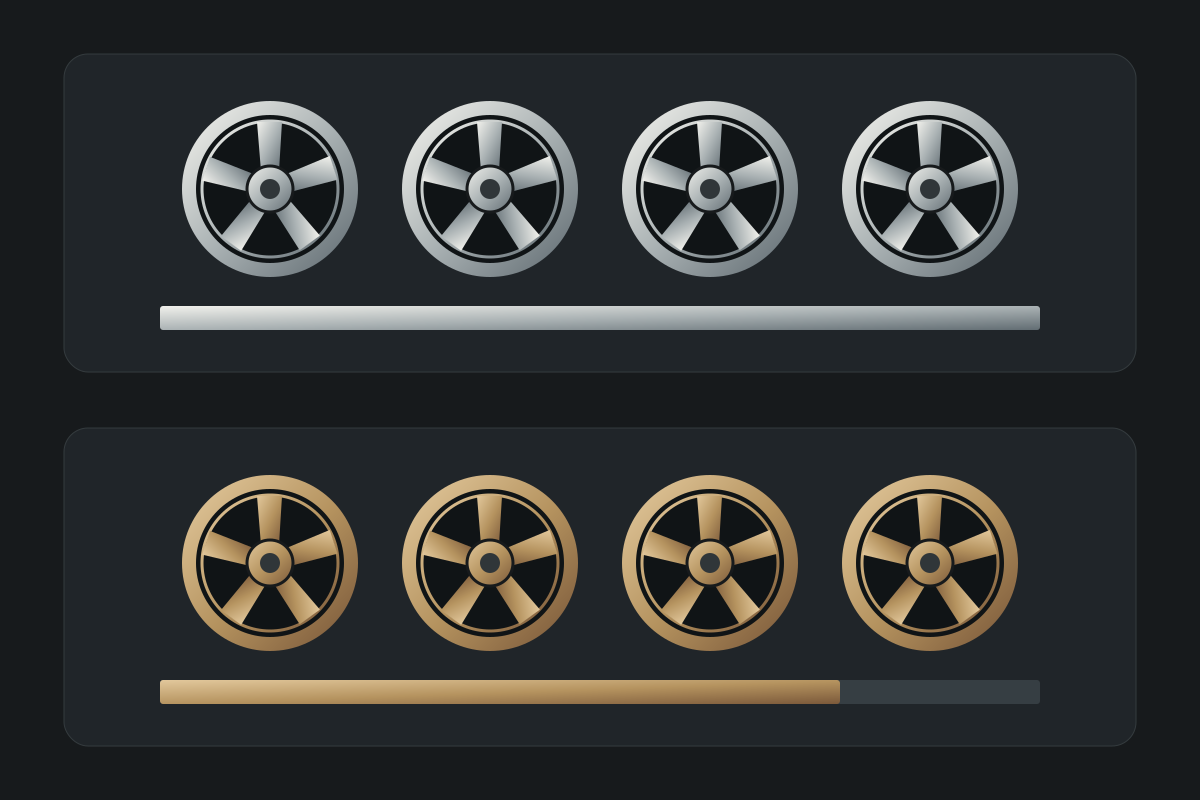 Upper silver row: four hypothetical 11.0 kg wheels, totalling 44.0 kg. Lower bronze row: four hypothetical 8.5 kg wheels, totalling 34.0 kg. Bar lengths show the set masses; wheel symbols do not identify construction. Original hand-authored SVG created for this article.
Include the tyres in your final calculation. If each new tyre adds 1.5 kg, the package saves only 4 × (2.5 − 1.5) = 4.0 kg. Compare both complete assemblies before accepting a promised benefit.
Strength needs evidence
Three terms help you read the specification. Strength concerns deformation and failure. Stiffness concerns how much the wheel deflects under load. Fatigue is damage that develops under repeated loading. Treat them as separate questions, rather than interchangeable ways of saying a wheel is good.
Enkei explains that casting and forging do not greatly change the aluminium alloy's elastic stiffness. Wheel geometry matters: the spoke sections, their arrangement and the rim profile. Its engineering discussion is a useful correction to the idea that “forged” automatically means a stiffer finished wheel.
Ask for the wheel's maximum applicable load and the test or approval documents relevant to your exact specification. Have the supplier confirm that these meet your vehicle's requirements. OZ's mounting manual specifically distinguishes a maximum applicable load from a VIA approval load. Do not treat every number stamped on a wheel as the same rating.
Testing examines the whole design. The Japan Light Alloy Automotive Wheel Testing Council describes cornering fatigue, radial fatigue and impact tests for VIA's general-application route. BBS also describes computer analysis followed by destructive testing. A claim about a manufacturing process is less useful than evidence tied to the product you will buy.
Keep the same discipline with damage. “Cast always cracks; forged always bends” is too simple to use as a buying rule. Your inspection decision should follow the condition of the actual wheel and its manufacturer's instructions. RAYS's user manual warns about deformation and cracking after impacts, and prohibits modifications involving welding or bending.
If a wheel develops a crack, deformation, air leak or unusual vibration, stop safely and seek professional advice before continued use. Forged construction is not permission to ignore damage or to assume a repair will restore the original properties.
What the extra money buys
A forged wheel involves substantial forming equipment and multiple production stages, as the OTTO FUCHS manufacturing sequence shows. The price you pay also concerns a particular design and specification. Use quotations for actual candidates instead of assigning one universal price to each method.
A manufacturer example makes the possible gap concrete. On 8 October 2026, RAYS's Japanese product tables listed these one-piece wheels with the same nominal diameter, width and bolt pattern:
| Wheel | Construction | Size and bolt pattern | Offset and finish | List price per wheel, before Japanese tax |
|---|---|---|---|---|
| RAYS gramLIGHTS 57DR SPEC D | Cast | 18x8.5J, 5x114.3 | +37 mm, AZZ | ¥59,000 |
| RAYS VOLK RACING TE37 SAGA S-plus | Forged | 18x8.5J, 5x114.3 | +35 mm, MM | ¥105,000 |
Four wheels at those prices total ¥236,000 and ¥420,000, a difference of ¥184,000 before tax. These are Japanese list prices, not quotations for your country. The designs, finishes and offsets differ, so the table is a buying example rather than a controlled comparison or a fitment recommendation.
Request a price for the complete package: wheels, tyres, valves or sensors, appropriate fasteners, fitting and balancing. Confirm what the quotation includes. If you import a set, ask for the delivered price with the taxes and charges applicable to your destination.
Then request the cost and availability of one replacement wheel. A set you can afford once may be a poor match if replacing a damaged corner would derail the rest of your project. Ask about the same size and finish, rather than assuming any wheel from the range will match.
Use the premium as a decision test. What verified benefit does it buy for this build, and what other work would you postpone to pay it?
Match the choice to your everyday needs
For a daily driver, consider a suitable cast wheel when its price, weight and appearance meet your brief. Give flow-formed wheels a place on the shortlist if their documented figures improve that balance. A forged option deserves the same comparison; you do not have to reject it simply because the car spends most of its time commuting.
For rough roads, put the wheel and tyre combination ahead of the construction label. Ask your fitter whether an approved alternative size would suit your use, and follow the vehicle's pressure recommendations. RAYS notes in its user manual that low pressure, particularly with low-profile tyres, reduces impact absorption and adds stress. Paying for forging does not resolve an unsuitable tyre package.
For regular track days, tell the manufacturer or supplier how you intend to use the car. Ask about suitable models, load requirements, inspection instructions and warranty terms for that use. Forged wheels can be candidates when their verified weight and design justify the cost. Flow-formed options also deserve assessment: BBS identifies cast flow-formed products used in factory racing programmes. That is evidence for considering the method, rather than approval for every road wheel on a circuit.
For a show or weekend build, be honest about appearance as a priority. You may prefer the finish or shape of a cast design, or want a particular forged model. Either can be a reason to buy after the technical checks. There is no need to turn a visual preference into an unsupported performance claim.
ImagineMyRide can help with that part of the decision: select your vehicle from the catalogue and compare available wheel choices with real wrap colours and finishes in AI-generated previews. Use those previews to judge the combination you like. Ask the supplier and fitter to establish construction and physical fitment separately.
Confirm the specification before you order
Give the supplier your exact model year, vehicle version, brake package and any suspension changes. Ask for confirmation against the manufacturer's application information. OZ's installation instructions place the vehicle application and load requirements before fitting.
Your final shortlist should include these checks:
- Dimensions and position: confirm diameter, width and offset, which describes the position of the mounting face relative to the wheel's centreline. Ask the fitter to check clearance at the brakes, bodywork and suspension.
- Hub and fasteners: confirm the bolt pattern, centre bore and specified nuts or bolts. Matching the number of holes is only part of the check.
- Load and tyre package: obtain the maximum applicable wheel load and an approved tyre combination with the required load and speed ratings. Include pressure-sensor compatibility where your vehicle needs it.
- Product evidence: keep the exact part number, construction description, weight for that specification, relevant test documents and installation instructions.
- Ownership costs: confirm the delivered total, replacement availability, finish-care instructions and terms for your intended road or track use.
RAYS gives detailed checks for size, mounting position and fasteners. Follow the instructions supplied with your chosen product. Ask your inspection authority about local approval requirements and tell your insurer about the proposed change before buying.
For a used set, request its history and arrange an inspection before committing. If the part number, condition or previous repair work cannot be established, leave it off the shortlist. A prestigious construction method does not answer those missing questions.
The right wheel is the one whose specification, evidence and ownership cost suit the car you actually use. Choose cast when it meets that brief, flow-formed when it offers the better balance, and forged when the verified benefits or desired design earn the premium.