Matte vs Satin vs Gloss: Choosing Your Car’s Finish
Most people choose a car colour first and think about the finish later. The finish is the level of shine on the surface. It decides how much of the world the car reflects, how dark or bright the colour looks, and how you will wash it for the next several years. The same teal can look like wet ink in gloss, like brushed metal in satin and like chalk-dusted stone in matte.
This guide explains what the three finishes are, how they change the colour you see, and what each one asks of you in daily use. It covers factory paint and vinyl wrap film, because the care rules are similar but the costs of a mistake are not. It ends with the questions to answer before you commit.
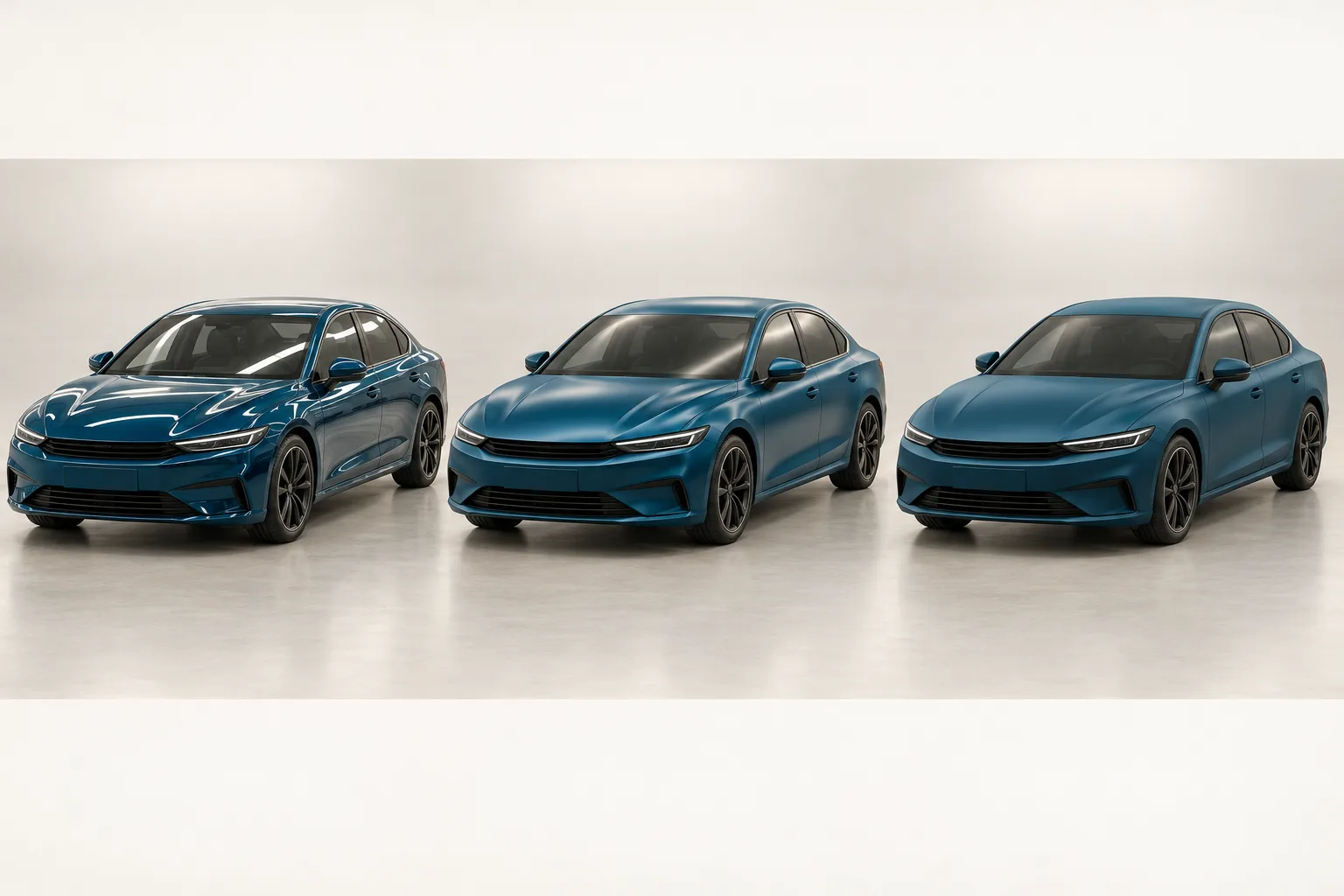 From left: gloss, with sharp, mirror-like reflections; satin, with a soft, blurred sheen; and matte, with flat, even
colour. The colour is the same on all three cars. Original AI-generated illustration created for this article.
From left: gloss, with sharp, mirror-like reflections; satin, with a soft, blurred sheen; and matte, with flat, even
colour. The colour is the same on all three cars. Original AI-generated illustration created for this article.
The short answer
If you want the easiest life, choose gloss. It is the familiar finish, it accepts approved car-care products, and light marks can often be polished or heated out. Choose matte if you want the most distinctive look and you accept stricter washing rules and more expensive repairs. Satin sits between the two: it softens reflections without going completely flat.
| Gloss | Satin | Matte | |
|---|---|---|---|
| Look | Deep colour, sharp reflections | Soft sheen, blurred highlights | Flat colour, no clear reflections |
| Shows the car’s shape through | Reflections | Soft highlights | Shading only |
| Wax and polish | Usually allowed | Check the product guide | Not allowed |
| Light scratches | Often polished or heated out | Harder to correct | Often cannot be corrected |
The rest of this article explains each row. The rules for your car come from the paint or film manufacturer, so treat the table as a summary, not a care manual.
What gloss, satin and matte actually mean
The three words describe one property: how much light a surface reflects in a single, mirror-like direction. Engineers call this specular gloss. The American standard ASTM D523 says that gloss "is associated with the capacity of a surface to reflect more light in directions close to the specular than in others".
A glossmeter shines a beam at the surface at a fixed angle and measures how much light comes back at the mirror angle. The result is given in gloss units (GU). The scale is set by a polished black glass reference, which reads 100 GU at the specified angle. A real mirror can read far higher, so 100 GU does not mean "perfect".
Most measurements start at an angle of 60°. Rhopoint Instruments, a glossmeter maker, explains the convention: a surface below 10 GU at 60° is measured again at 85°, which suits matte surfaces, and a surface above 70 GU is measured again at 20°, which suits high gloss. The 60° angle is for the middle range between 10 and 70 GU.
Wrap film makers publish figures on this scale. Avery Dennison’s Supreme Wrapping Film datasheet gives these values at 60°:
- Gloss: more than 85 GU
- Satin: 20–30 GU
- Matte: less than 15 GU
These are one manufacturer’s ranges. There is no single standard that defines "satin" for cars, so one brand’s satin can be shinier than another brand’s. Two finishes with the same name are not always the same, which is the best reason to look at a real sample before you choose.
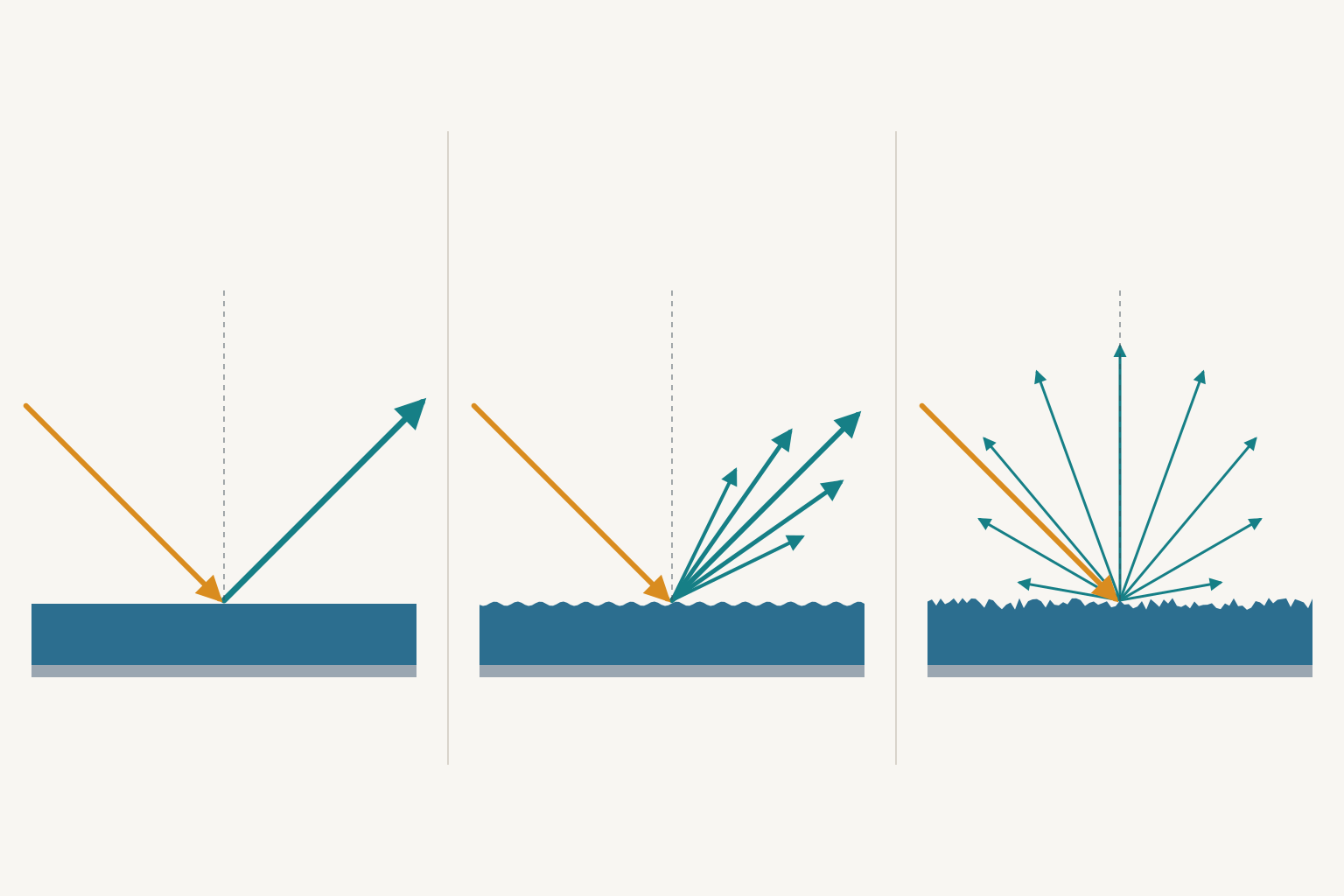 How each finish reflects light. Orange arrows show the incoming light and teal arrows the reflected light; the dashed
line is perpendicular to the surface. From left: gloss, where most light leaves at the mirror angle; satin, where the
reflection spreads into a wider cone; and matte, where light scatters in many directions. Schematic only: the surface
roughness is greatly exaggerated. Original hand-made illustration created for this article.
How each finish reflects light. Orange arrows show the incoming light and teal arrows the reflected light; the dashed
line is perpendicular to the surface. From left: gloss, where most light leaves at the mirror angle; satin, where the
reflection spreads into a wider cone; and matte, where light scatters in many directions. Schematic only: the surface
roughness is greatly exaggerated. Original hand-made illustration created for this article.
How the finish changes the colour you see
The finish changes more than the shine. It also changes how dark and how strong the colour looks.
On a smooth surface, the reflected white light travels mostly in one direction. When you look from any other angle, you see the pigment with little white light on top of it. On a matte surface, microscopic roughness scatters that white light in all directions, so some of it reaches your eye from every angle. HunterLab, which makes colour-measurement instruments, describes the result: the matte colour appears "lighter and less saturated", and glossy objects "look darker than objects with a rough surface, even if they contain the same pigmentation".
In practice, this means three things:
- A matte version of a colour looks paler and softer. A deep red in gloss can look closer to brick in matte.
- Gloss makes dark colours look deeper. Black and dark blue in gloss look richer because less white light mixes in.
- The finish changes how the shape reads. On gloss, you see the car’s curves through reflections of the sky, the street and the lights. On matte, there are no reflections, so you see the shape only through light and shadow. Sharp creases and large flat panels look very graphic in matte; soft, rounded bodies can look heavier.
Because of this, a small swatch held flat in a shop can be misleading. Look at a sample on a curved panel, outdoors, in both direct sun and cloud, before you decide.
Gloss: deep colour and familiar care
Gloss is the finish most people picture when they think of car paint. The reflections hide nothing: they show the quality of the bodywork, and they also show swirl marks, fine scratches and water spots. That sounds like a weakness, but gloss is also the most forgiving finish to correct.
Gloss film is made with the same goal as gloss paint. 3M’s 2080 product bulletin describes its high gloss colours as "providing a mirror-like appearance". The same bulletin warns installers and owners to "use care to avoid scratching the film. Never scrub the film."
When a gloss surface does get marked, you have options:
- Polish. The Mercedes-Benz manual quoted below calls paint cleaners, polishes and wax products "only suitable for high-gloss surfaces". For film, 3M’s maintenance bulletin names a finishing polish that owners "can try" on glossy 2080 film. Wrap film is much thinner than paint, so only use a product that the film maker approves.
- Heat. 3M’s 2080 maintenance FAQ says that "most mild surface scratches will disappear when exposed to sunlight on warm days", and that a heat gun can also help. It adds that deeper scratches "will not come out with heat and would require replacement".
The trade-off is that very high gloss shows every wash mark. The same FAQ asks owners to take "extreme care" when they wash 2080 high gloss film. If you choose gloss in a dark colour, plan to wash it by hand with good technique.
Satin: the middle ground
Satin gives a soft glow instead of a reflection. Highlights spread out into broad bands, so the car’s shape stays easy to read, but the surface looks calmer than gloss. Many people find that it suits greys and dark tones, and it is worth a look if you like matte but want a little depth.
There is no industry-wide definition of satin. Avery Dennison’s 20–30 GU range puts its satin film far below its gloss film and only a little above its matte film. In other words, satin is much closer to matte than to gloss in measured shine, even if it looks like a compromise.
For care, the safest approach is to treat satin like matte unless the film maker says otherwise. Avery Dennison’s cleaning bulletin recommends its own Supreme Wrap Care products on gloss and satin film, but notes possible "slight streaking" on matte. 3M groups its care warnings under "matte or textured film or other films with unique finishes". Read the care guide for your exact product line.
Like matte, satin cannot be polished back to its original look in the way that gloss can. A polish adds shine, so a polished patch on satin can look like a bright stain.
Matte: dramatic and less forgiving
Matte is the boldest choice. With no reflections, the colour looks solid and the car looks almost like a scale model. It is also the finish with the strictest rules, because the low shine depends on a rough surface texture that rubbing can flatten.
Every manufacturer source we checked gives the same message:
- No wax or polish. 3M says: "Do NOT use any polishing or wax products on matte or textured films." Avery Dennison warns that matte film is "subject to extreme color and gloss shift when exposed to cleaners, wax, and polish".
- Scratches are hard to correct. 3M warns that on matte film, "scratching and abrasion marks may be visible and users may not be able to work them out".
- Factory matte paint has the same limits. The Mercedes-Benz SLC operator’s manual says: "Never polish the vehicle or the light alloy wheels. Polishing causes the finish to shine." It also lists frequent automatic car washes and washing in direct sunlight as causes of unwanted shine, and forbids wash programmes with hot wax.
- Fingerprints show more. 3M’s FAQ notes that matte film "may show fingerprints more prominently".
Repairs are the biggest hidden cost, because a matte repair cannot be polished in to match the surrounding surface. Kia’s UK owner’s manual states that on matte paint "it is impossible to modify only the damaged area and repair of the whole part is necessary". A small scrape on one door can mean a complete door. Ask your insurer and a bodyshop what a matte repair would cost before you buy.
Paint or wrap?
You can get each finish in two ways: paint or wrap film. A wrap is a thin vinyl film that a specialist applies over the existing paint. If your car did not leave the factory in matte or satin, a wrap is usually the practical way to get that look.
A wrap has clear advantages for a matte or satin look:
- It can be removed. The original paint stays under the film, so you can return to the factory finish later.
- Damage is panel by panel. If a matte door is scratched, the installer can replace the film on that door. That is the same "whole part" logic as matte paint, but the paint underneath is not touched.
- The choice is wider. Major film makers offer gloss, satin and matte in the same colours. ORAFOL’s ORACAL 970RA datasheet lists colours "with a high glossy or matt finish", and 3M lists gloss, satin and matte 2080 films.
A wrap also has limits. ORAFOL states plainly that "by nature films are more sensitive than lacquers". Film has a rated life. 3M’s warranty matrix gives 2080 film up to 8 years on vertical surfaces and 3 years on horizontal surfaces such as the bonnet and roof, in its mildest climate zone. Avery Dennison rates most Supreme Wrapping Film colours at 10 years vertical and 5 years horizontal, with shorter ratings for metallic, pearlescent and some special colours. The datasheet also says that "abrasion and loss of gloss are not covered by any Avery Dennison Warranty".
We found no manufacturer that gives matte film a shorter rated life than gloss as a rule. The three makers we checked rate durability by colour family, not by finish. Some named matte and satin colours do have shorter ratings, so check the datasheet for the exact colour you want.
Caring for each finish
The basics are the same for all three finishes on a wrap: wash by hand when you can, use a mild, non-abrasive car shampoo, and remove contaminants quickly. 3M asks for cleaners with a pH value between 3 and 11 and without solvents. The differences are in what you add afterwards.
| Task | Gloss | Satin | Matte |
|---|---|---|---|
| Hand wash with car shampoo | Yes | Yes | Yes |
| Wax or polish | Only approved products | Follow the film maker’s guide | Never |
| Brush car wash | Avoid on wrap film | Avoid | Avoid |
| Bird droppings and sap | Remove quickly | Remove quickly | Remove at once |
Some details from the manufacturers:
- Car washes. 3M’s FAQ says that brush car washes "may dull and scratch the film and/or lift the edge of the graphics", and recommends a touchless wash if you must use one. Avery Dennison’s European bulletin is less strict and allows conventional washing, with pressure-washer limits of 80 bar, 70 °C water and a minimum nozzle distance of 75 cm.
- Contaminants. 3M recommends soaking bug splatter, bird droppings and tree sap "for several minutes with hot, soapy water", not scrubbing them. Avery Dennison says to treat them "as soon as possible to prevent damage".
- Fuel. 3M says to wipe fuel spills off immediately, because fuel can degrade the vinyl and the adhesive.
- Alcohol cleaners. The makers disagree here. 3M recommends a mixture of 70 % isopropyl alcohol and 30 % water to remove fingerprints from matte film. Avery Dennison’s Asia-Pacific bulletin tells owners to avoid isopropyl alcohol on the surface. Follow the guide for the film on your car, and ask your installer which film that is.
For factory matte paint, follow the owner’s manual of your car. The Mercedes-Benz manual quoted above recommends washing by hand with a soft sponge, car shampoo and plenty of water.
The paperwork in the UK
A change of finish can also be a change of colour, and that has two practical consequences in the UK.
First, the registration certificate. GOV.UK says that you must update your V5C when you change the colour of the vehicle. The guidance does not mention wraps or finishes, so if you change the colour with a wrap and you are not sure whether it counts, ask the DVLA.
Second, insurance. The Financial Ombudsman Service lists custom paintwork among car modifications and says that failure to declare modifications can lead to claims being rejected. Its advice is to "contact your insurer to clarify what needs to be declared". The RAC’s guide to modified car insurance names vinyl wraps directly. Tell your insurer before the work is done, and ask whether a matte repair would be covered at full cost.
Rules in other countries are different. If you live outside the UK, check with the vehicle registration authority and your insurer.
How to choose
Answer these questions honestly before you choose:
- How is the car washed today? If it goes through a brush car wash every week, matte and satin will not suit that routine. Gloss will.
- Where is the car parked? Under trees or near the coast, contaminants land quickly. Matte needs you to remove them at once.
- What colour do you want? Dark colours gain depth in gloss. Many people like greys and mid-tones in satin. Bright colours in matte become softer and more pastel.
- What shape is the car? Sharp creases suit matte. Curvy, flowing bodies show their form best in gloss.
- How long will you keep the look? If you may change your mind or sell the car soon, a wrap keeps the original paint intact.
- What would a repair cost? Ask a bodyshop or wrap installer for a price to repair one door in each finish.
Then compare the finishes on your own car, not in a brochure. Because the finish changes how light and dark the colour looks, the same swatch can surprise you in a different finish. ImagineMyRide lets you specify your exact car and preview real wrap colours in gloss, satin and matte side by side before you visit an installer. Use the previews to narrow the choice, then confirm it with a physical sample in daylight.
Final thoughts
Gloss is the safe and versatile choice. It makes colours look deep and is the most forgiving to maintain and repair. Satin gives a softer, modern look with only a little more care. Matte is the most striking, but it asks for careful washing, no polish and more expensive repairs.
No finish is better in every situation. The best one is the finish that suits your colour, your car’s shape and the way you actually use and wash the car.