Staggered vs Square Wheel Setups: What’s the Difference?
A square setup uses the same wheel diameter, wheel width and tyre size at the front and rear. A staggered setup uses different specifications between the axles, usually with wider rear wheels and tyres. The wheel diameters can match or differ: Tesla’s factory Model 3 specifications show a width difference with matching diameters, while Porsche’s 2020 911 Carrera 4 specification uses different diameters too.
The useful question is which complete wheel and tyre combination your particular car supports. Start with its approved specification, then compare appearance, maintenance and the way you use it. Neither layout is automatically compatible because the wheels look right in the arches.
What do square and staggered mean?
Think of the setup as two pairs: the front axle and the rear axle. “Square” describes matching sizes across those pairs. It does not mean that the car has square-shaped wheels, or that front and rear tyre pressures must be identical.
“Staggered” describes a difference between the pairs. There are two useful distinctions:
- Width stagger: front and rear wheels have different widths, often with different tyre widths, but the wheel diameter stays the same.
- Diameter stagger: the rear wheel diameter differs from the front, usually alongside a width difference.
A factory example makes width stagger clear. Tesla lists 20-inch Model 3 front wheels with a rim width of 228.6 mm (9 inches) and rear wheels at 254 mm (10 inches), with 235/35 R20 front tyres and 275/30 R20 rear tyres. Both wheels are 20 inches in diameter. These are entries in the manufacturer’s package table, not permission to install that package on every Model 3.
Be precise when a seller describes a set as square. Ask whether that means four equal tyre sizes, equal wheel dimensions, or four identical wheel part numbers. Those descriptions can lead to different answers about where an assembled wheel can fit. You will see a factory example of this distinction below.
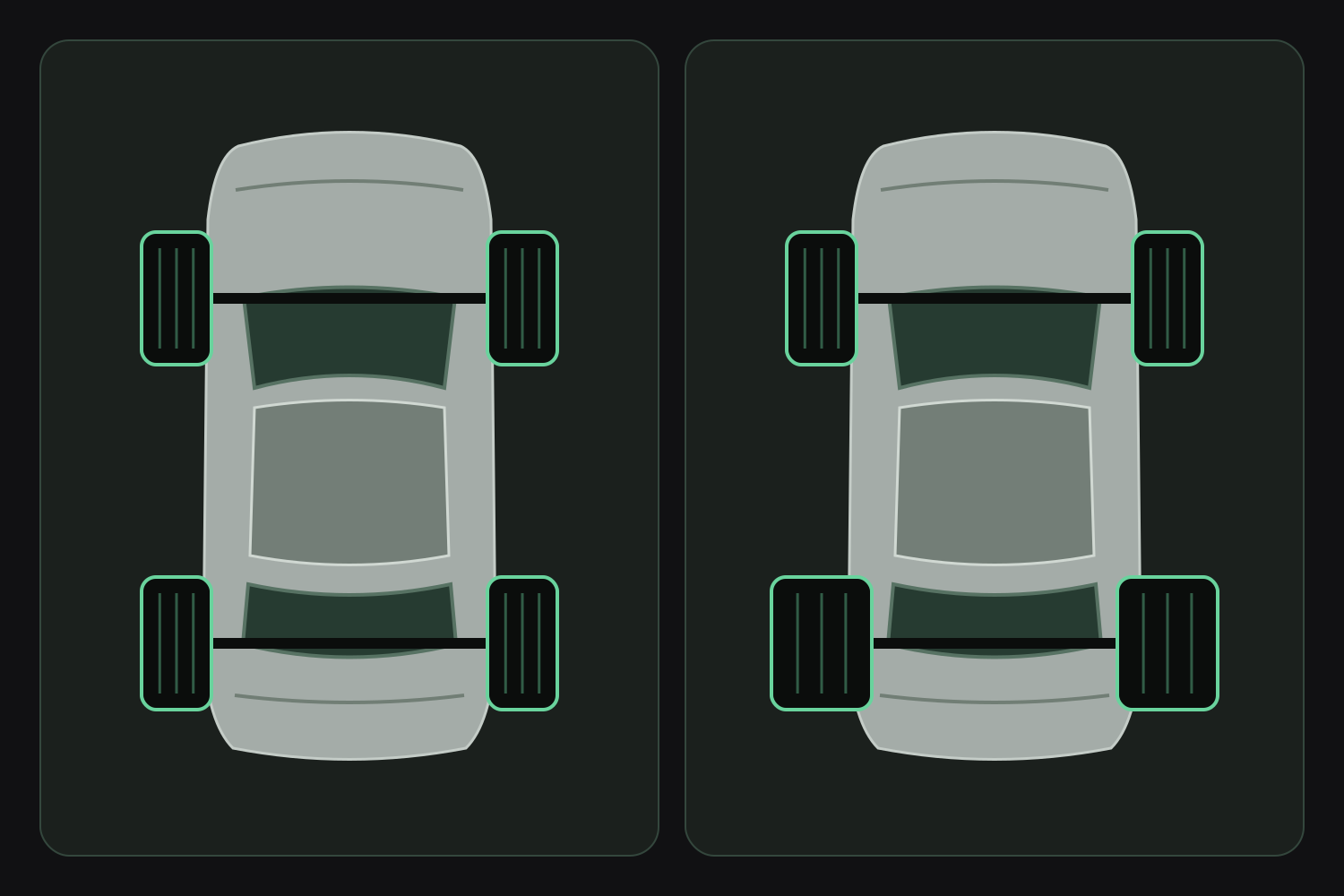 From left: a square setup and a width-staggered setup, with the front of each car at the top. The rear tyres on the right are wider; their illustrated length stays the same. The shapes are schematic, without a vehicle-specific scale. Original hand-authored SVG illustration created for this article.
Why do manufacturers choose staggered wheels?
A staggered package can serve a particular vehicle’s traction and handling requirements. It also changes the visual relationship between the front and rear wheels. The engineering reason needs to come from the manufacturer rather than from the appearance of a wider tyre.
For the Model 3 Performance introduced in April 2024, Tesla describes the larger rear tyre alongside its rear-biased torque delivery. Tesla says the combination improves traction as the car leaves a corner. Its account also includes suspension changes and control-system calibration. That is evidence for this particular factory package, rather than a promise about every staggered conversion.
For your own car, ask what problem a size change would solve. More space filled in the rear arch is an appearance goal. A different response to steering is a handling goal. Treat each as a separate reason to compare an approved option.
The width printed on a tyre cannot settle the performance question by itself. Michelin’s tyre-selection guidance also considers driving conditions, tyre type and the owner’s priorities. Compare the actual tyre products available in both axle sizes, especially if your roads are frequently wet or your car needs winter tyres.
A square arrangement has a different practical attraction: where the wheels are interchangeable and the handbook permits it, tyres can change axle positions. Michelin explains that rotation helps distribute wear. That can matter more to an everyday owner than a wider rear wheel. It still does not establish that converting a factory staggered car to square will preserve its intended behaviour.
Does the drivetrain decide compatibility?
The drivetrain is the system that delivers power to the wheels. Front-wheel drive (FWD), rear-wheel drive (RWD) and all-wheel drive (AWD) describe which wheels receive that power. They give useful context, but the approved combination for the exact vehicle remains the deciding evidence.
Front-wheel drive: do not assume that a wider rear tyre helps the wheels that propel the car. If the car has an approved square arrangement, make that your starting point. Michelin’s rotation guide explains that front tyres on an FWD car carry steering, braking and drive loads. Changing rear width alone does not answer how the front tyres will perform.
Rear-wheel drive: a factory staggered package can reflect a performance requirement at the rear. Michelin describes manufacturer-specified staggered fitment for RWD performance. RWD itself does not approve an arbitrary wider rear wheel. Ask for the combination specified for your model year, trim and brake package.
All-wheel drive: staggered is possible when the manufacturer designs the vehicle for it. The 2020 Porsche 911 Carrera 4 is an AWD example with 19-inch front and 20-inch rear wheels. Its approved pairing is evidence about that model, not another AWD car.
Other AWD systems have different restrictions. Ford’s guidance for the AWD system in this manual warns that major front-to-rear tyre-size differences can disable or damage the system. It also addresses differences between new and significantly worn tyres. Request the actual manufacturer requirements for size and wear; do not substitute a generic percentage rule.
Electric cars: an electric powertrain does not settle the question either. Tesla’s factory table includes square and staggered packages, while Polestar’s example below separates wheel width from tyre size. Michelin also identifies load capacity and rolling resistance as considerations for electric vehicles. Check the complete specification rather than choosing by propulsion type.
Factory examples: read the whole specification
These examples show how different the arrangements can be. In the wheel codes, J identifies the rim-flange profile; the numbers give width and diameter in inches, as Polestar’s notation guide explains. Read each linked document for its model and package restrictions; this table is a comparison, not a fitment list for your car.
| Vehicle or documented package | Front | Rear | What it shows |
|---|---|---|---|
| Tesla Model 3, factory 18-inch package | 18 x 8.5J; 235/45 R18 | 18 x 8.5J; 235/45 R18 | Matching wheel and tyre dimensions |
| Model 3 Performance, introduced April 2024, with the documented 20-inch package | 20 x 9.0J; 235/35 R20 | 20 x 10.0J; 275/30 R20 | Width stagger with equal wheel diameters |
| 2020 Porsche 911 Carrera 4, launch specification | 19-inch wheel; 235/40 ZR 19 | 20-inch wheel; 295/35 ZR 20 | An AWD example with width and diameter differences |
| 2024 Polestar 2, standard 19-inch combination | 8J x 19; 245/45 R19 | 9J x 19; 245/45 R19 | Equal tyre sizes with different wheel widths |
Wheel listings can put width or diameter first. Read both dimensions rather than assuming the first number always means the same thing.
The Polestar row deserves attention. Its tyres match, but its front and rear rims do not. The manual explicitly prohibits swapping the wheels between axles. You cannot identify a fully interchangeable square set from the tyre sidewalls alone.
It also states that the standard 19-inch and 20-inch wheels are unsuitable for the Performance Pack, whose brakes require 20-inch Performance wheels. The same model name and even the same wheel diameter therefore do not prove clearance. This is why a specialist needs the trim and brake specification as well as the model.
Wheel diameter is not tyre diameter
A 20-inch wheel measurement describes the rim that supports the tyre. It does not describe the total diameter of the wheel and tyre together. Likewise, a wider tyre does not necessarily have a much larger outside diameter.
Michelin explains tyre-size notation: the first number is nominal width in millimetres; the second is sidewall height as a percentage of that width; the number after R is rim diameter in inches. You can use these values for a first geometric comparison.
Consider 225/45 R18 at the front and 255/40 R18 at the rear. This is an arithmetic example, not a recommended combination for any vehicle:
- Front sidewall: 225 × 0.45 = 101.25 mm.
- Rear sidewall: 255 × 0.40 = 102 mm.
- Front nominal outside diameter: 18 × 25.4 + 2 × 101.25 = 659.7 mm.
- Rear nominal outside diameter: 18 × 25.4 + 2 × 102 = 661.2 mm.
The nominal difference is 1.5 mm, or approximately 0.23% relative to the front: 1.5 ÷ 659.7 × 100. The rear tyre is wider, but the lower aspect ratio keeps its calculated diameter close to the front tyre’s.
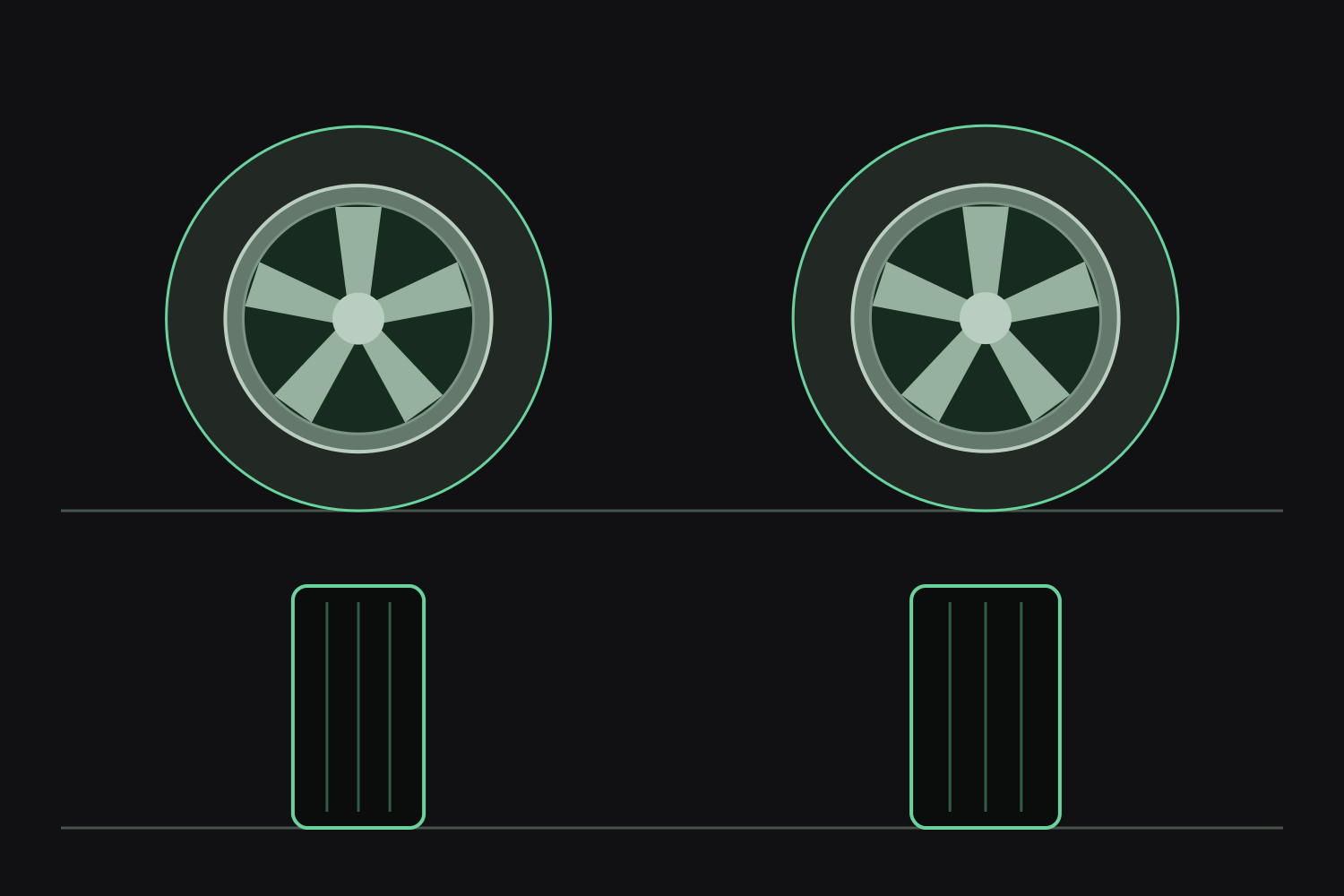 From left: 225/45 R18, calculated diameter 659.7 mm, and 255/40 R18, calculated diameter 661.2 mm. The circles use one scale; the lower profiles compare nominal widths of 225 mm and 255 mm. Original hand-authored SVG illustration created for this article. These dimensions illustrate the calculation and do not confirm fitment.
This calculation is a screening tool. Michelin notes that actual diameters can differ between tyre models. Continental’s product specifications give dimensions and revolutions per mile for particular tyres. Ask the manufacturer or specialist which data your vehicle requires. A close calculated diameter does not confirm drivetrain compatibility, the correct tyre-to-rim pairing or clearance.
Rotation, wear and replacement costs
Tyre rotation means changing tyre positions to distribute wear. With matching, interchangeable assemblies, a handbook may permit movement from front to rear. With different axle sizes, that option disappears. The exact pattern still depends on the vehicle and tyre: Pirelli’s rotation guidance distinguishes uniform, directional and different-size arrangements.
A directional tyre is designed to roll in one specified direction. An assembled directional wheel cannot simply move across the car if that reverses the tyre’s direction. An asymmetric tyre instead has a specified inner and outer side; check for a direction requirement separately. Tesla’s manual explains asymmetric mounting and allows side-to-side rotation for non-directional staggered tyres. Follow your own handbook and ask the fitter which moves it permits.
For a staggered set, plan purchases around two axle specifications. Ask for a quote covering two front tyres and two rear tyres in the intended product range. Check that both sizes are available with the required ratings and season type. Compare the total fitted price, rather than the price of one front tyre.
Do not assume that square is always cheaper or that staggered always wears faster. The useful comparison is between the approved packages and actual tyres available for your car. Rotation opportunities are one part of that calculation, alongside the replacement schedule and the condition of the tyres already fitted.
Replacement guidance also needs its full context. Michelin’s recommendation to put two new tyres at the rear applies to equal front and rear tyre sizes. On a staggered car, you cannot move a new front-size pair to the rear to follow that advice. Ask the tyre specialist how to preserve the required axle sizes and acceptable wear balance.
Can you convert from one setup to the other?
Treat a conversion as a new fitment proposal. Do not order four front wheels for a staggered car, or two wider rear wheels for a square car, until the manufacturer or a qualified specialist confirms the complete combination.
Prepare the existing and proposed specifications for both axles. Give the specialist your model year, trim, market, brake package and any suspension changes. Ask them to verify:
- Vehicle approval and load: is this complete combination approved for this exact version, with the required wheel load capacity, or does it need a separate assessment?
- Wheel attachment: do the fixing-hole pattern, centre bore and required fasteners match the application?
- Position and clearance: do width, offset and wheel shape clear the brakes, suspension and body throughout steering and suspension movement?
- Tyre compatibility: is the exact tyre approved for the rim width, with the vehicle’s required load and speed ratings?
- Vehicle systems: what tyre dimensions, wear limits, pressure-monitoring procedures and wheel-configuration settings does the manufacturer require?
Offset is the distance between the wheel’s centre line and its mounting face, measured in millimetres. The centre bore is the hole that locates over the hub. OZ Racing defines these measurements separately from the fixing-hole circle. A matching bolt pattern alone cannot answer all those questions.
RONAL’s fitting instructions require the relevant vehicle approval and a clearance check before tyre mounting. Continental lists an approved rim-width range for each tyre specification. Request confirmation for the actual parts, rather than relying on a photograph or a calculator.
A winter package is another complete combination to check. Tesla’s Canadian 19-inch winter package for 2024+ Model 3 Performance has narrower front than rear wheels and tyres. A smaller approved winter wheel therefore need not mean square. Check the package for your market, and ask your insurer and local inspection authority what documentation a proposed change requires.
Choose for the car and the way you use it
Begin with the manufacturer-approved specification for your car. If you want a different appearance, compare the approved alternatives before you consider a conversion. Ask the fitter to write both axle specifications on the quote, including tyre product, wheel part number, width, diameter and offset.
If the car supports a fully interchangeable square package, consider whether its permitted rotation pattern suits your maintenance priorities. If it specifies staggered wheels, compare the cost and availability of both tyre sizes. Retaining the specified arrangement gives you a documented starting point; any proposed change still needs confirmation for the exact car.
For tyre choice, write down the conditions you actually drive in: rain, cold weather, motorway journeys or rough local roads. Michelin’s selection guidance makes those conditions part of the decision alongside vehicle requirements. Square and staggered describe dimensions; neither word selects the right tyre product for those conditions.
For the appearance decision, ImagineMyRide lets you specify a vehicle from its catalogue and preview wheel models with real wrap colours and finishes. Use that to compare the visual combination. Keep the fitment decision with the manufacturer and tyre specialist, who can confirm the actual parts and measurements.
Before payment, you should have a clear front specification, a clear rear specification and an explanation of the permitted maintenance pattern. That makes the choice concrete: the wheels you like, in a complete combination confirmed for your particular vehicle.